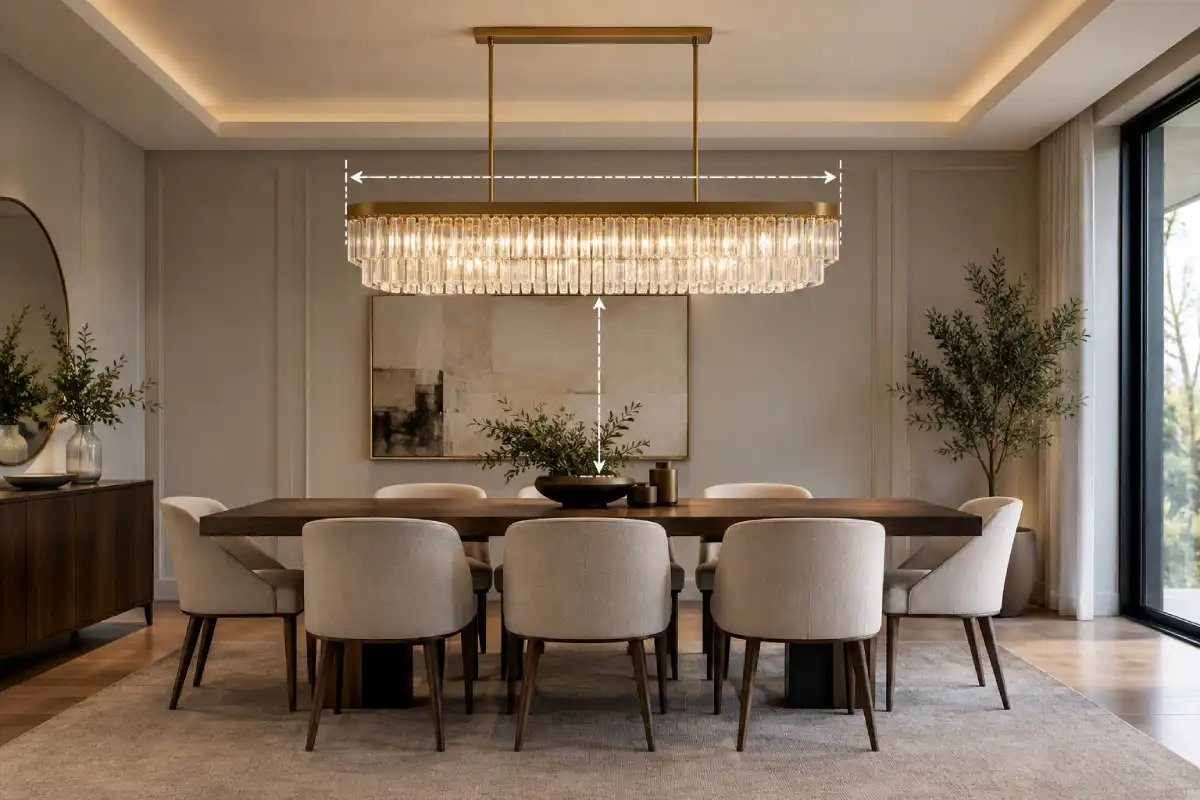
Dining Table Chandelier Sizing Cheat Sheet: How Big Should Your Chandelier Be?
A lot of dining room chandeliers that look slightly wrong are actually beautiful pieces. The crystal is good, the finish is good, the design is right for the house. They’re just too small for the table, or hung 20 centimetres too high, and that alone is enough to make an expensive light look like an afterthought.
A dining table chandelier has a different job from the one in your living room or foyer. It has to belong to one piece of furniture: the table. Get that relationship right and the whole room feels finished, even before anyone sits down.
This dining table chandelier sizing cheat sheet gives you the actual numbers for width, hanging height, high ceilings and long tables, plus the sizing mistakes we see most often in homes across Dubai and the UAE. Measurements are in centimetres first with inches in brackets, so grab a tape measure and your table’s dimensions before you start.
Width & Height Rules of Thumb
A dining table chandelier should be roughly half to two-thirds the width of the table, and its lowest point should sit 75 to 90 cm (30 to 36 in) above the tabletop. Those two numbers cover most dining rooms with a standard ceiling of 2.4 to 2.7 m.
If you only save one thing from this cheat sheet, make it this table.
| What you’re sizing | Rule of thumb | Worked example |
| Chandelier width | 1/2 to 2/3 of the table’s width | 100 cm wide table: chandelier 50-67 cm across |
| Hanging height | Bottom of the fixture 75-90 cm (30-36 in) above the tabletop | Standard 75 cm table: bottom of the light sits 150-165 cm from the floor |
| Taller ceilings | Raise it about 7.5 cm (3 in) for every extra 30 cm (1 ft) of ceiling above 2.4 m | 3 m ceiling: roughly 90-105 cm above the table |
| Fixture height (top to bottom) | About 6-7.5 cm for every 30 cm of ceiling height (2.5-3 in per foot) | 2.7 m ceiling: a chandelier around 55-70 cm tall |
| Long tables (over about 2.4 m) | A linear piece around 1/2 to 2/3 of the table’s length, or two matching chandeliers | 2.7 m table: linear chandelier of about 135-180 cm |
Treat these as a starting range, not a law. A very open, airy crystal design can go a little bigger than the numbers suggest, and a solid drum or heavy metal frame usually looks better at the smaller end. The sections below explain where each number comes from and when to bend it.
Matching Chandelier Width to Table Width
Measure the width of the table, the short side, and multiply it by 0.5 and by 0.67. That gives you the diameter range for your dining table chandelier.
read more about Everything about Bespoke Chandelier Project in Dubai
The reason is practical. At that size the light covers the middle of the table where the food is, and you still have 15 to 30 cm of clearance on each side. People can stand up, lean over to pour water or reach for a dish without their head ending up inside a crystal arm. Go wider than the table and guests on the ends start to feel boxed in, and the light spills onto chair backs instead of the table.
| Table width | Chandelier diameter |
| 80 cm (31 in) | 40-53 cm (16-21 in) |
| 90 cm (35 in) | 45-60 cm (18-24 in) |
| 100 cm (39 in) | 50-67 cm (20-26 in) |
| 110 cm (43 in) | 55-73 cm (22-29 in) |
| 120 cm (47 in) | 60-80 cm (24-31 in) |
| 150 cm round (59 in) | 75-100 cm (30-39 in) |
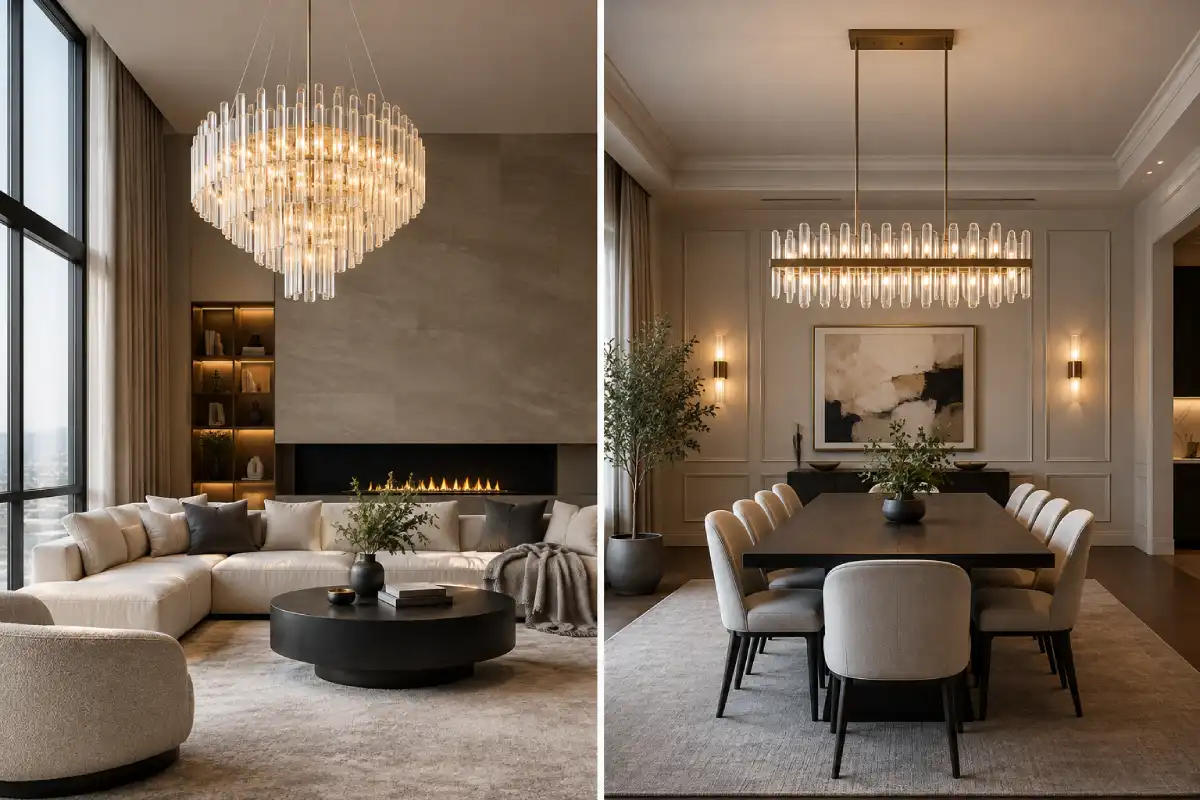
Shape matters as much as width. A round or square table sits naturally under a round chandelier, and a large round table for eight or ten people can carry a tiered piece at the top of the range. A rectangular table up to about 1.8 m long usually works with a single round fixture. Past that length, an oval or linear design follows the table and lights both ends evenly.
If the dining area is part of an open-plan space, there’s one more check worth doing. Add the room’s length and width in metres, then multiply by 8.3 to get a diameter in centimetres (in feet, the sum gives you inches). A 5 m by 4 m zone gives you about 75 cm. When that number and the table number disagree, go with the table, then make sure the result doesn’t look tiny against the wider room.
How High to Hang It Above the Table
Hang your dining table chandelier so its lowest point is 75 to 90 cm (30 to 36 in) above the tabletop. Measure from the table, not the floor. Tables vary more than people expect, and a 78 cm table with a thick top changes the result.
This range comes from how people actually sit. Seated eye level for most adults is roughly 110 to 120 cm from the floor. With a standard 75 cm table, a fixture hung 75 to 90 cm above it puts the bottom of the light at 150 to 165 cm, which is above everyone’s line of sight. Guests can see each other across the table, and the light still feels close enough to belong to the meal.
Hang it higher and two things happen. The chandelier starts to look like it’s attached to the ceiling rather than the table, and diners begin to catch the bare bulbs or LED points in their eyes from below. Hang it lower and you’ll spend every dinner party looking around it.
You can also work backwards to find the tallest chandelier your room will take. Take your ceiling height, subtract the table height, then subtract the gap you want above the table. For a 2.7 m ceiling, that’s 270 minus 75 minus 80, which leaves 115 cm for the chandelier body plus its chain or rod and canopy. Anything taller than that will either sit too low or crowd the ceiling.
One small tip from installation days: ask your installer to leave some extra chain or cable before the final fix. Have someone sit at the table, look across at another seated person, and adjust a few centimetres up or down until it feels right. Pair that with a dimmer and warm light around 2700K to 3000K, and the table will feel comfortable at lunch and at a late dinner.
Adjusting for High Ceilings or Long Tables
The standard chandelier sizing numbers assume a 2.4 to 2.7 m ceiling and a table of normal length. Plenty of villas and penthouses in Dubai have neither, so here’s how to adapt.
Ceilings of 3 m and above
For every 30 cm of ceiling above 2.4 m, raise the chandelier by about 7.5 cm. A 3 m ceiling puts the bottom of the light around 90 to 105 cm above the table. That extra lift keeps the fixture in proportion with the taller room without cutting it off from the table.
Height of the chandelier itself should grow too. Using the 6 to 7.5 cm per 30 cm rule, a 3 m ceiling suits a fixture roughly 65 to 75 cm tall. You can also push the width toward the top of the range from the earlier table, because the extra volume of air above the table makes a mid-sized piece look smaller than it really is.
Double-height dining rooms
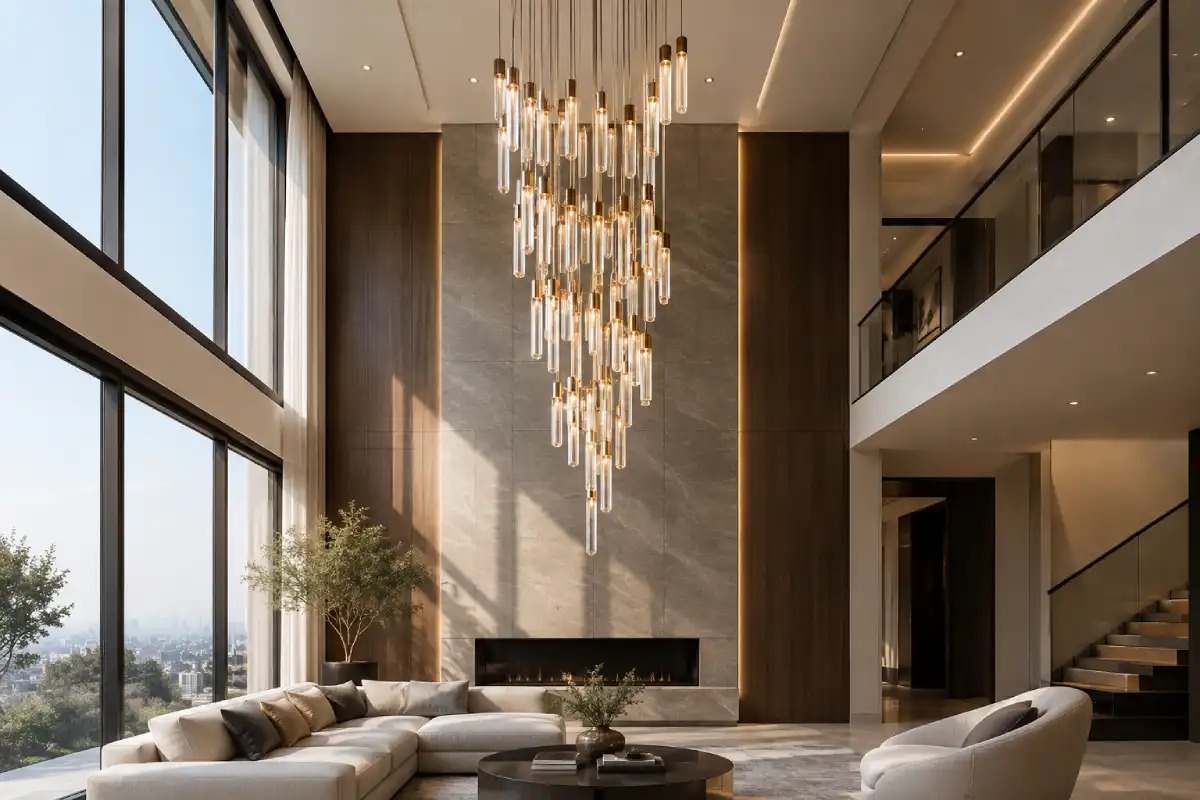
This is where people most often go wrong. With a 5 or 6 m ceiling, the temptation is to hang the chandelier high so it fills the void. Resist it. The bottom of the fixture should still sit close to the table, around 90 to 110 cm above it, and the chandelier’s own vertical length should do the work of filling the space.
Tiered, cascading and multi-level designs suit these rooms because they carry the eye upward. On a 6 m ceiling, a chandelier around 125 to 150 cm tall is a sensible starting point. Avoid a small fixture on a very long bare chain, which tends to look like it was bought for a different room. A decorative rod, a chain cover or a design that’s taller by nature solves that.
Two practical points before you order. A large crystal piece can weigh a lot, and many UAE homes have gypsum false ceilings that can’t take that load alone, so the fixing needs to go into the concrete slab above. Plan this before the ceiling is finished. If the chandelier will be hard to reach for cleaning, ask about a motorised lift that lowers it to table height.
Tables longer than about 2.4 m
Once a table seats ten or more, a single round chandelier lights the middle and leaves both ends in shadow. You have two good options.
The first is a linear or oval chandelier about half to two-thirds the length of the table. On a 3 m table that means roughly 150 to 200 cm, with at least 30 cm of table showing beyond each end. Its width should still follow the half to two-thirds rule against the table’s width.
The second is two or three matching chandeliers. Divide the table into equal sections and centre one fixture over each. On a 3 m table with two lights, that puts them about 75 cm in from each end and 150 cm apart centre to centre. Size each one slightly smaller than you would a single chandelier, so the pair reads as a set and the table doesn’t feel crowded from above.
Common Sizing Mistakes to Avoid
Most chandelier sizing problems over a dining table come from a handful of decisions made early, often before the furniture even arrives. These are the ones we run into most.
Going small to play it safe. This is the most common one by far. A 45 cm chandelier over a 1 m wide, 2.2 m long table almost always looks undersized once it’s up, even if it looked generous in the showroom. If you’re torn between two sizes, the larger one is usually the right call for a dining table.
Sizing to the room and forgetting the table. A chandelier that’s perfect for a 6 m by 5 m room can still swamp a small round table for four. The table is the anchor. Use the room only as a secondary check.
Leaving it where the electrician put it. Ceiling points are often fixed during construction, long before anyone decides where the table goes. If the point isn’t centred over the table, the chandelier won’t be either. It’s far easier to move the point during fit-out than to live with a light that’s 30 cm off.
Hanging it too high. Installers sometimes hang the fixture high because it’s quicker and keeps it out of the way. Check the 75 to 90 cm gap before they pack up their tools.
Forgetting the table extends. If you have an extension leaf, size for the length you use most days. A linear piece that looks right at 2.2 m will usually still work when the table opens to 2.8 m for guests.
Ignoring visual weight. Two chandeliers with the same diameter can feel completely different in a room. An open frame with clear crystal reads light and can go bigger. A solid drum shade or dense dark metal reads heavy and usually needs to come down a size.
Judging scale from a photo. Product photos rarely show anything for scale, and a 60 cm piece and a 90 cm piece can look identical on a screen. Cut a circle of cardboard to your chosen diameter, or mark it on the tabletop with painter’s tape, and look at it from the doorway before you commit.
FAQ
Is there a simple formula for dining table chandelier size?
Yes. Multiply your table’s width by 0.5 and 0.67 to get the diameter range, then hang the bottom of the fixture 75 to 90 cm above the tabletop. For every 30 cm of ceiling above 2.4 m, raise it by about 7.5 cm. Those three steps cover most dining rooms.
What size chandelier do I need for a 6-seater dining table?
A typical 6-seater rectangular table is around 180 cm long and 90 cm wide, so a round chandelier of 45 to 60 cm (18 to 24 in) suits it well. If your 6-seater is round, base the size on its diameter instead.
What size chandelier works for an 8-seater table?
Most 8-seaters are 220 to 240 cm long and about 100 cm wide. A round chandelier of 50 to 67 cm works, but at that length a linear or oval piece of around 110 to 160 cm often lights the table more evenly.
Can a chandelier be too big for a dining table?
Yes. Once it’s wider than about two-thirds of the table, or closer than 15 cm to the table’s edge on either side, it starts to crowd the people sitting there. In a double-height room you have more freedom with height, but the width rule still applies.
How high should a chandelier hang over a round table?
The same as over a rectangular one: 75 to 90 cm (30 to 36 in) from the tabletop to the bottom of the fixture, adding about 7.5 cm for every 30 cm of ceiling above 2.4 m.
Does the chandelier have to match the shape of the table?
Not strictly, but it helps. Round and square tables pair naturally with round fixtures. Long rectangular tables usually look and light better with a linear or oval chandelier, or a pair of matching ones.
Do I need a dimmer for a dining room chandelier?
We’d always recommend one. The same light that’s right for a family lunch is far too bright for a late dinner, and a dimmer lets one fixture handle both. Warm light between 2700K and 3000K is the most flattering for food and faces.
Get a Custom-Sized Chandelier for Your Table
The numbers in this sizing cheat sheet will get you close. The trouble with ready-made chandeliers is that they come in fixed sizes, and your table, ceiling and room rarely line up neatly with any of them. You end up choosing between 60 cm and 80 cm when your table really wants 70.
A custom-sized bespoke chandelier starts from your measurements instead. At Lorenzo, we design each piece around the space it’s going into, so the diameter, the drop, the number of tiers and the overall length are set by your table and ceiling rather than by a catalogue. That matters most in the rooms where standard sizes struggle: double-height dining halls, extra-long tables and open-plan spaces where the dining area has to hold its own.
If you’re sizing a dining table chandelier for a home in Dubai or anywhere in the UAE, send us your table dimensions, your ceiling height and a couple of photos of the room. We’ll come back with a size and a design direction that fit the space. Get in touch with the Lorenzo team to start the conversation.