Custom LED Chandeliers: Bespoke Design Meets Modern Lighting Technology
Say “LED” to a client commissioning a bespoke piece and some will picture an office ceiling, not a crystal chandelier over a formal room. That reputation is out of date. Nearly every large custom chandelier made today, including ones with traditional crystal and hand-finished metalwork, runs on LED sources specified for that exact fixture, not picked up as a generic bulb afterward.
What Is a Custom LED Chandelier
In a custom LED chandelier, the light source is engineered together with the design. Color temperature, dimming compatibility and where the source sits in the frame get settled at the same stage as tier count and crystal grade.
That’s a different job from dropping LED candelabra bulbs into a traditional frame built for incandescent sockets. Retrofits work, but they tend to give something up: color quality, smooth dimming, or the way light moves through the crystal. A piece designed around LED from the start sidesteps most of that, since the fixture and the light source were never two separate decisions.
Benefits of LED Technology in Bespoke Chandelier Design
A lower electricity bill is usually where the conversation starts. The gains go further, though. Efficiency, control and lifespan improve together, which is a big part of why LED became the default instead of an upgrade option.
| Incandescent | Halogen | LED | |
|---|---|---|---|
| Typical lifespan | ~1,000 hours | 2,000 to 4,000 hours | 15,000 to 25,000+ hours |
| Wattage for 60W-equivalent brightness | 60W | 40 to 50W | 8 to 10W |
| Heat at the light source | High | Higher than incandescent | Low |
Energy Efficiency and Lower Running Costs
An LED matching the brightness of a 60-watt incandescent draws about 8 to 10 watts. That’s around 85 percent less energy for the same light. On a large tiered chandelier with dozens of light points, the saving over a year is real money.
The lower draw helps the wiring, too. A fixture pulling a fraction of what an older multi-bulb chandelier needed puts less demand on the circuit feeding it, which matters once a piece has forty or more light points.
Smart Controls, Dimming, and Color Options
Incandescent and halogen never offered this kind of control. A single chandelier can be zoned into independent circuits and dimmed smoothly through its full range, not just the top end. It can sit warmer in the evening and cooler and brighter by day, which helps in a room that has to work for more than one occasion.
The catch is that all of it has to be built in from the start. Not every LED driver dims cleanly, and pairing the wrong driver with the wrong dimmer is a common source of flicker, or of a light that only dims through the top half of its range. Specifying compatible components together is the fix. It’s also the step that gets skipped when someone assumes any LED will run on any dimmer switch.
Longevity and Reduced Maintenance
LED sources commonly last 15,000 to 25,000 hours or more before output drops noticeably. A standard incandescent bulb gets around 1,000.
On a chandelier hung five or six meters up, in a hotel lobby or a stairwell, that gap stops being abstract. Every bulb change means scaffolding, a lift, or scheduling around whatever event is using the room that week.
Cooler running helps the crystal too. Incandescent and halogen bulbs can reach several hundred degrees at the glass, and years of heat sitting that close is part of why lower-grade crystal loses its clarity. LED sources stay far cooler at the point of contact, so the crystal around them carries less thermal stress.
Combining LED Technology With Traditional Materials (Crystal, Metal)
Crystal doesn’t generate any color of its own. It reflects and refracts whatever hits it, which is why color quality matters more here than with almost any other material. A low-CRI LED source, one that renders color poorly compared to natural light, can leave even high-grade crystal looking flat and washed out. Jewelers avoid the same problem by lighting gemstones with high-CRI sources instead of whatever bulb is cheapest. If sparkle is the point of the piece, 90 CRI or above is the threshold worth specifying.
Metal finish plays a role too, though a simpler one. Warmer color temperatures, close to candlelight, still suit burnished brass or aged bronze, same as always. Cooler, whiter light works better against matte black, gunmetal or polished chrome. None of that changes now that the source is LED. What does change is that the color temperature has to be chosen deliberately and not left at whatever a generic bulb defaults to.
Design Considerations for Custom LED Chandeliers
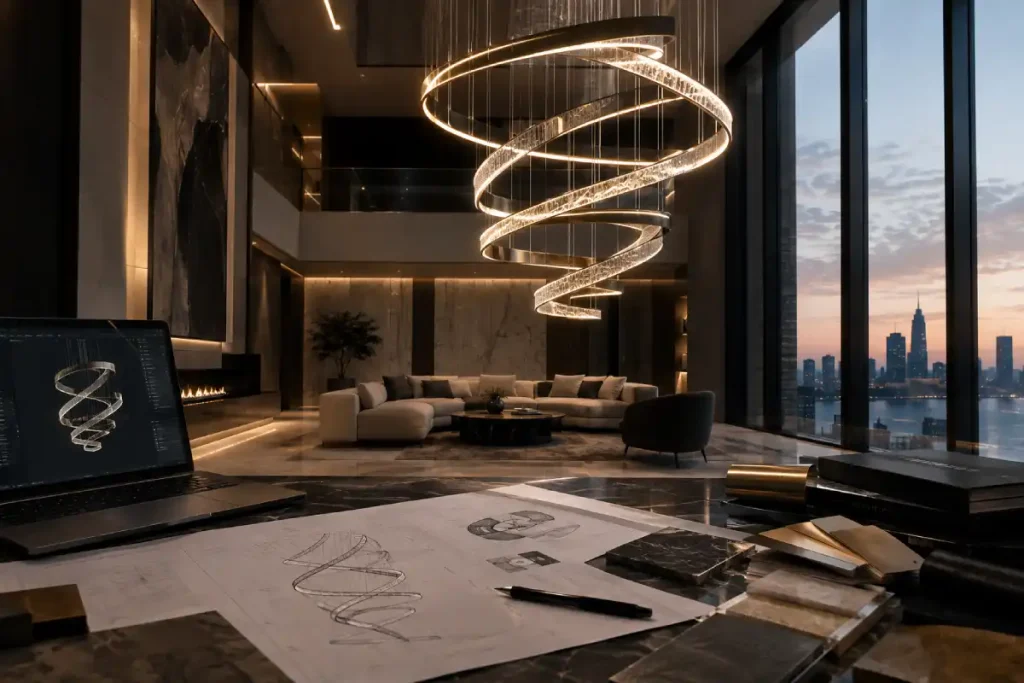
Building LED into a bespoke frame raises questions a traditional socket-and-bulb design never does. Take drivers, the components that convert household current into what an LED actually needs. They have to live somewhere, often hidden in the canopy or in a remote housing above the ceiling line, and that placement has to be worked into the structural mount from the start, not added afterward.
Serviceability is worth settling early too. An integrated LED module built into the frame can look cleaner, with no visible bulb or socket breaking up the crystal. The trade is that if something fails, the whole module gets replaced instead of a single bulb. Replaceable LED lamps in a more traditional socket give up a little of that unbroken look, and in return a repair doesn’t mean taking the fixture down. Neither approach is wrong, so long as somebody actually chose it.
Ideal Applications for LED Chandeliers in Modern and Classic Interiors
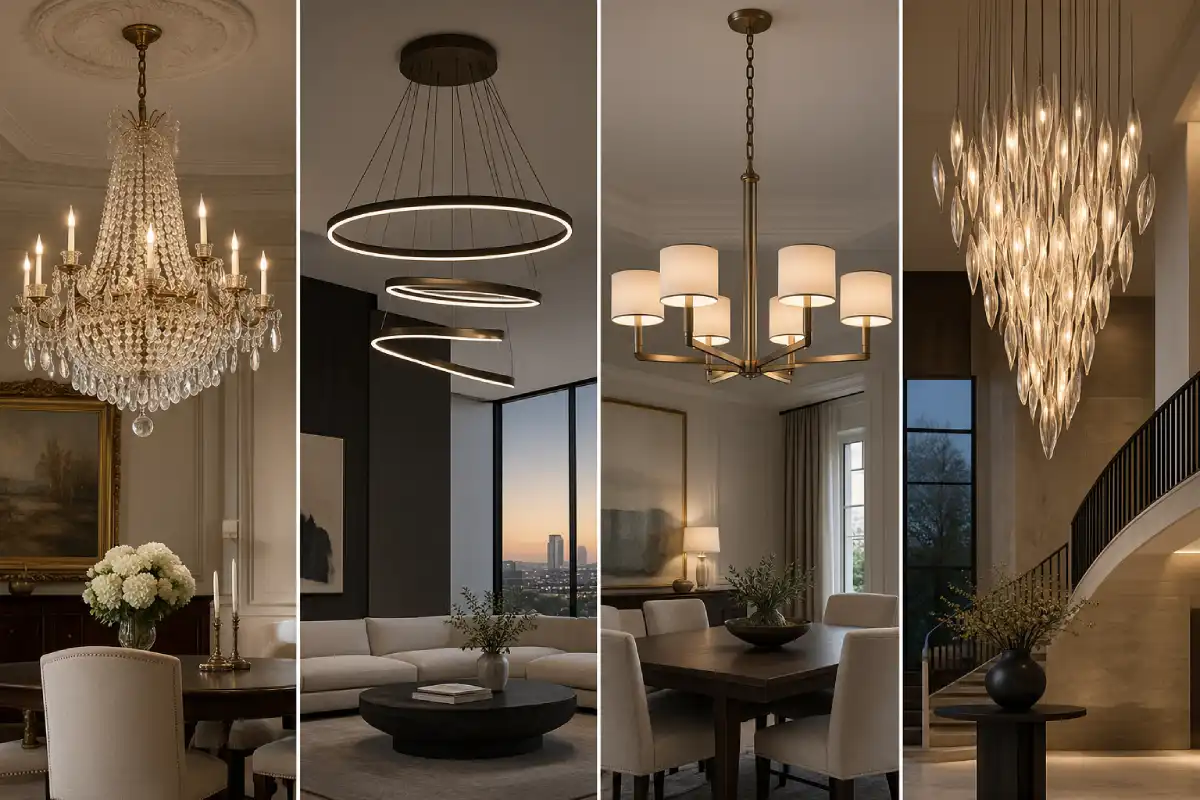
Modern and minimalist interiors are the obvious fit. A clean LED source suits a sculptural metal frame, and the crystal doesn’t have to carry the visual weight.
Classic and traditional rooms are less obvious, and they may benefit more. A warm, tunable LED can replicate candlelight closely enough that most people can’t tell by eye, and it adds dimming range and reliability that incandescent never had. A grand entry or a formal dining room gets the traditional look without the maintenance traditional bulbs required.
read more: Chandelier Style Guide: Classic, Modern, Transitional
Rooms with more than one job get the most from what LED adds. Picture a ballroom that needs full brightness for a daytime event and something dimmer and warmer for an evening reception. That used to mean a compromise fixture or a second lighting system altogether. Zoned, independently dimmable circuits built into the chandelier handle both, and neither look feels like an afterthought.
If a project is weighing whether LED suits a specific room and style, it usually comes down to a short conversation once Lorenzo’s custom chandelier design team has photos of the space and knows what the room needs to do beyond hanging there and looking good. Most classic and contemporary interiors can work with LED. Color temperature, CRI and how the drivers get hidden are the details worth getting right.