Chandelier Style Guide: Classic, Modern, Transitional & Statement | Which Is Right for Your place?
Most people know the kind of chandelier they like the moment they see it. Putting a name to it is harder. Is it classic or transitional? Is that ring piece modern, or is it a statement fixture? And will it actually suit the room it’s going into?
The labels matter less than the fit. A crystal chandelier that looks perfect in a marble foyer can feel heavy in a minimalist apartment, and a sleek linear piece can look out of place in a room full of carved wood and silk. This guide walks through the main chandelier styles, what defines each one, and where they tend to work best, so you can narrow things down before you start looking at designs.
How to Choose a Chandelier Style for Your Space
Before picking a style, look at what’s already in the room. A chandelier rarely sets the direction of an interior. It usually follows it, then pushes it a little further.
Four questions narrow things down quickly:
- What’s the architecture like? Cornices, arches and panelled walls point toward classic or transitional pieces. Flat ceilings, big glazing and clean lines lean modern.
- What are the main materials? Marble, dark timber and brass pair naturally with crystal and gilded frames. Concrete, pale oak and matte finishes suit glass, blackened metal or brushed brass.
- How big is the room, and how high is the ceiling? Some styles need height to look right. A tiered crystal chandelier squeezed under a 2.7 m ceiling loses most of its drama.
- Should the chandelier blend in or take over? Decide early whether it’s supporting the room or meant to be the first thing anyone notices.
It also helps to think about the whole floor, not just one room. In open-plan villas, the foyer, living area and dining table are often visible at once. The pieces don’t need to match, but they should look like they belong to the same house.
Classic & Antique Chandeliers
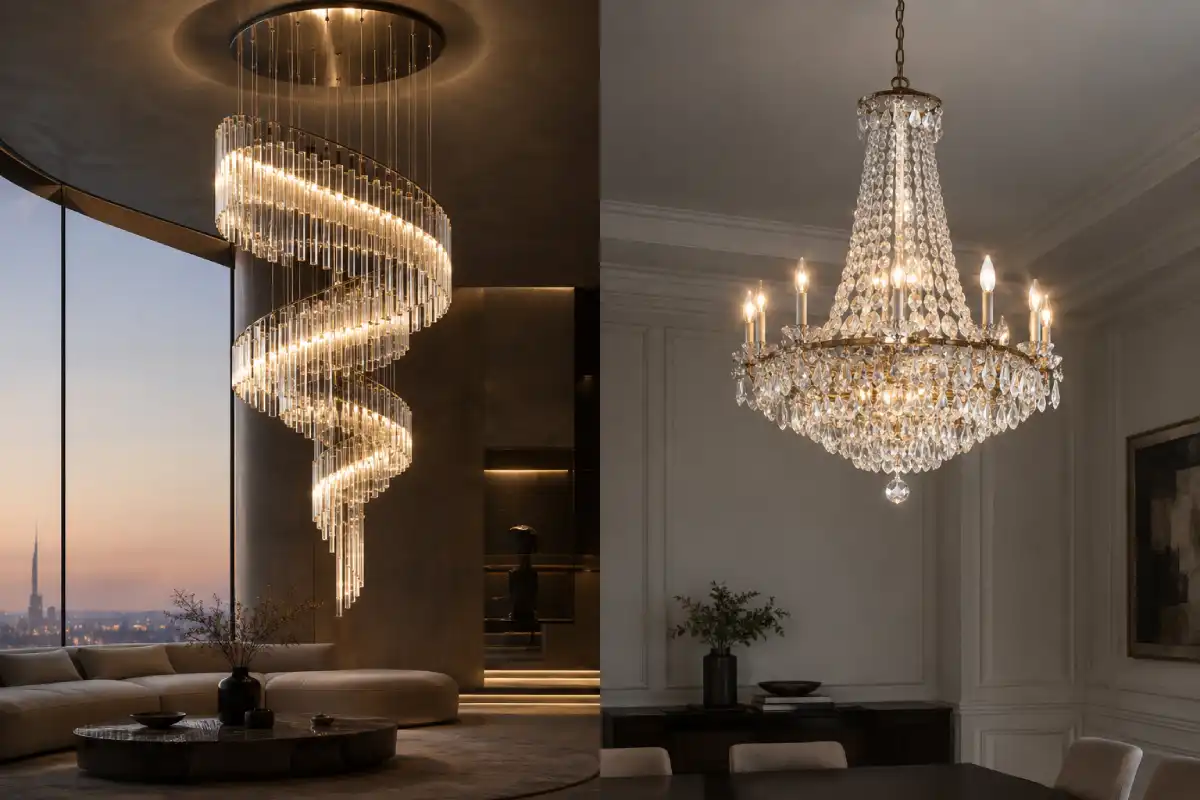
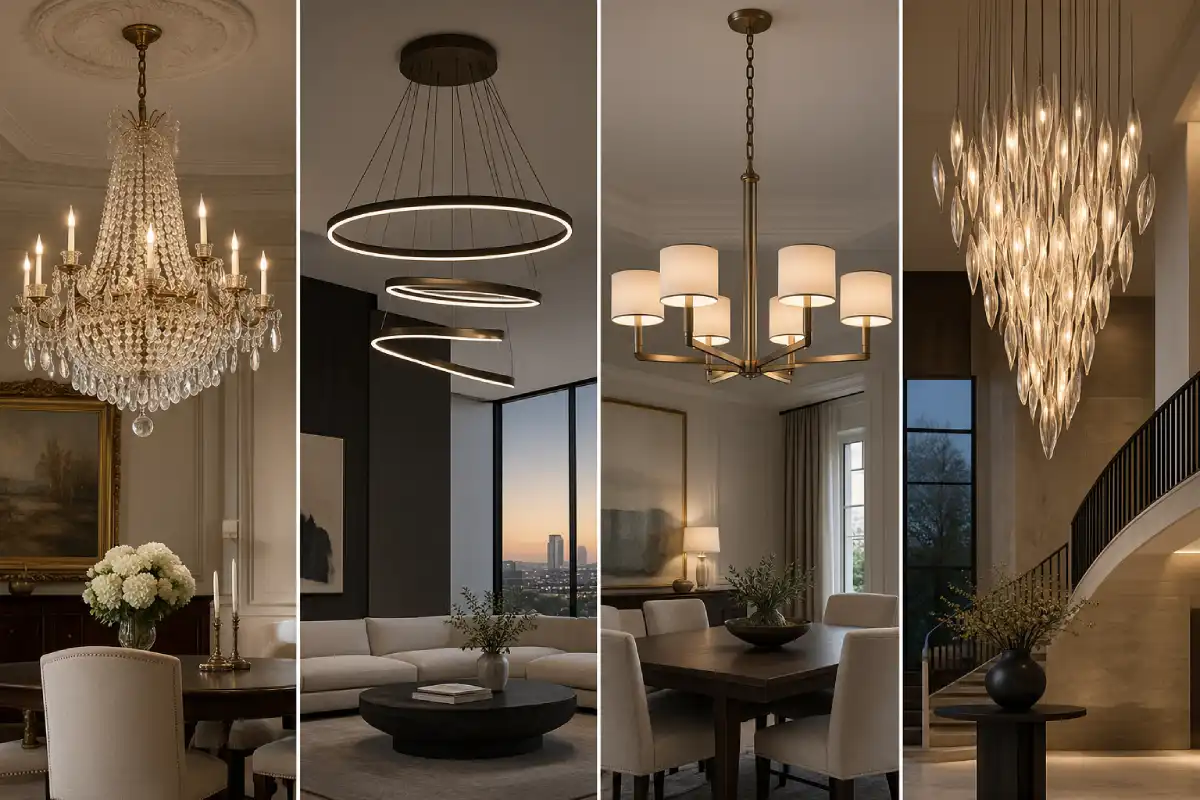
This is the chandelier most people picture first: curved arms, candle-style lights, layers of crystal drops and a gilded or brass frame. The look traces back to European palaces and grand houses, and versions of it still anchor formal interiors today.
What defines the style:
- Symmetrical, often tiered silhouettes
- Crystal pendants, prisms, chains and bobeches
- Gold, brass, bronze or silver-leaf finishes
- Candle sleeves, sometimes with small fabric or glass shades
Classic chandeliers suit formal majlis rooms, grand foyers, dining rooms and staircases in homes with traditional or neoclassical architecture. They need some height to breathe and work best with a high ceiling and a generous room.
Antique-inspired pieces lean toward an aged finish, softer patina and more irregular, hand-made detailing. They’re a good choice when you want a room to feel collected and lived-in rather than brand new. If you’re after a true period look, small things like the shape of the arms, how the crystals are cut and the colour of the metal make more difference than the overall size.
for more information, take a look at Foyer & Entryway Chandeliers article
Modern Chandeliers
Modern chandeliers drop most of the ornament and let the shape carry the design. Think simple geometry, clean lines and light sources that are part of the form rather than hidden among crystals.
You’ll usually see:
- Integrated LED instead of candle bulbs
- Hand-blown or frosted glass, acrylic, or fine metal rods
- Matte black, brushed brass, champagne or nickel finishes
- Asymmetric or abstract compositions
They work well in contemporary villas, apartments, open-plan living spaces and kitchens with an island. Because they’re visually lighter, modern pieces also cope better with lower ceilings, which makes them a practical choice for many apartments in Dubai Marina, Downtown and similar high-rise areas.
The risk with modern lighting is that it can feel cold if everything in the room is hard and minimal. Warm light (2700K to 3000K), a softer metal finish and some texture in the glass go a long way toward keeping it inviting.
Transitional Chandeliers
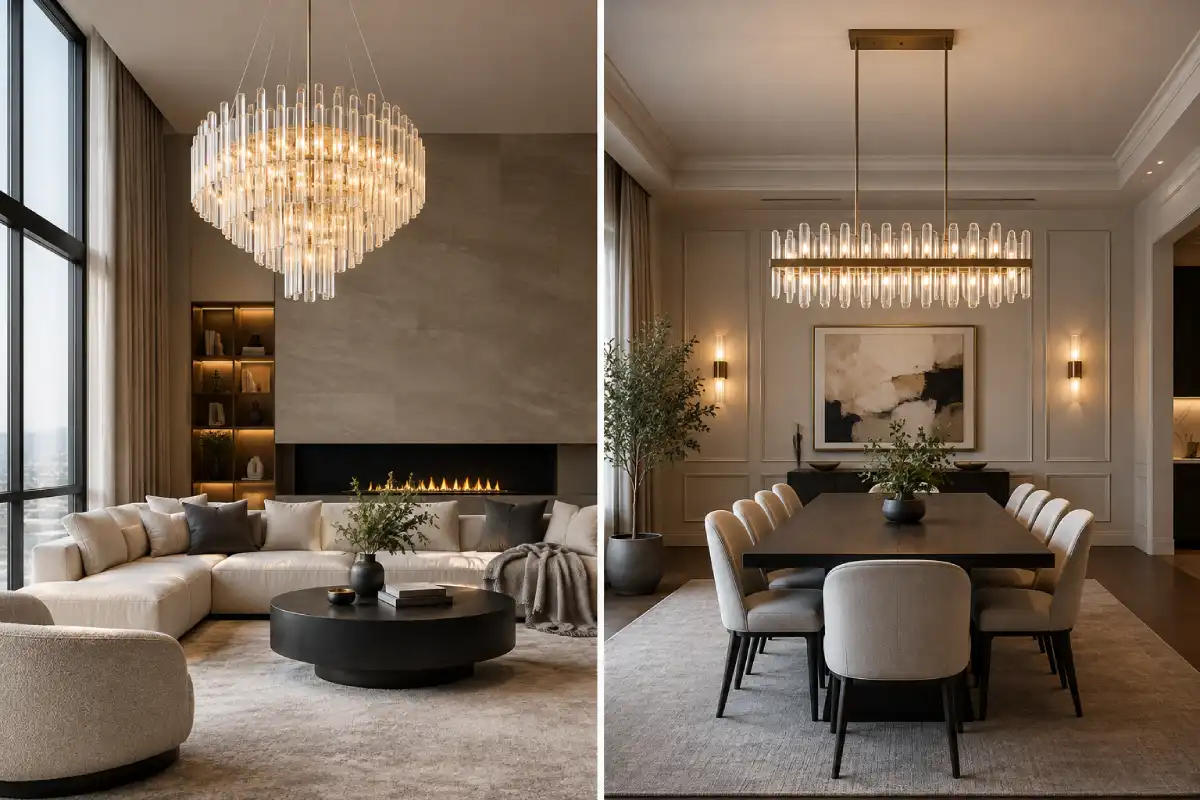
Transitional chandeliers sit between the two worlds. They keep the familiar shape of a classic chandelier, such as arms, tiers or a central column, but strip back the decoration and update the materials.
A typical transitional piece might have a traditional candle-arm frame in brushed brass with no crystals at all. Or it might keep the crystal but use clean, faceted drops on a simple modern frame instead of ornate chains and swags.
It’s an especially popular choice in new villas in the UAE, and for good reason. A lot of homes here mix classic architecture (arches, mouldings, marble floors) with contemporary furniture. A fully classic chandelier can push those rooms toward formal, and a fully modern one can clash with the architecture. Transitional pieces bridge the gap.
They’re also the safest choice if you’re unsure, or if the interior might evolve over the next few years. A good transitional chandelier ages well because it isn’t tied too closely to one trend.
Statement & Oversized Chandeliers
A statement chandelier is defined less by its style than by its role. It’s the piece the room is built around, and it can be classic, modern or anything in between.
What makes it a statement is usually some combination of:
- Scale, noticeably larger than a standard fixture for the space
- Form, with an unusual or sculptural shape
- Material, such as dense crystal, coloured glass or an unexpected metal finish
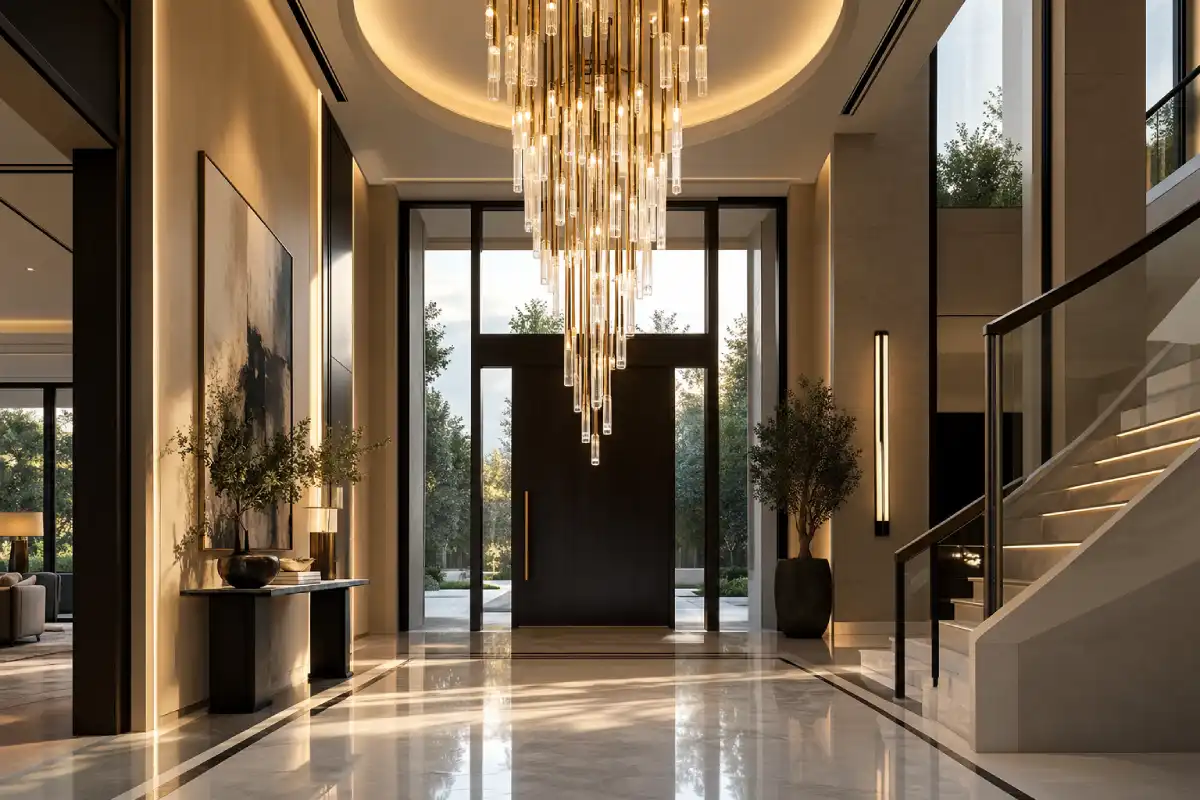
- Placement, in a double-height foyer, over a grand staircase or at the centre of a hotel-style lobby
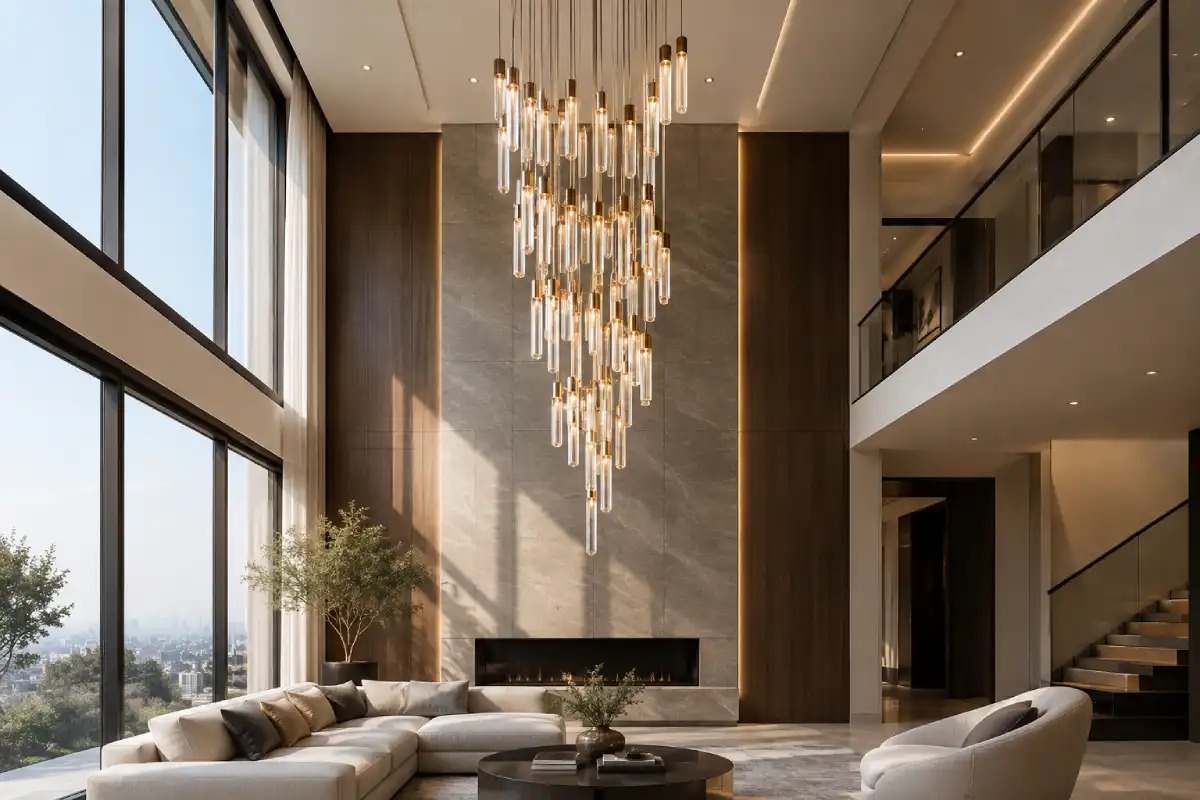
Oversized pieces need room. They look their best in double-height entrances, tall living rooms and long dining rooms, where there’s enough volume around them that they don’t crowd the space. In smaller rooms, a statement can still work, but it usually comes from a striking shape or material rather than sheer size.
Because statement chandeliers are so dependent on the room, this is where a bespoke statement chandelier makes the most sense. Sizing, weight, hanging height and maintenance access all need to be planned around the actual space rather than taken from a catalogue.
Linear, Ring & Tiered Chandeliers
These are shapes rather than styles. Each one can be made in a classic, modern or transitional way, and the shape is often decided by the room before the style is.
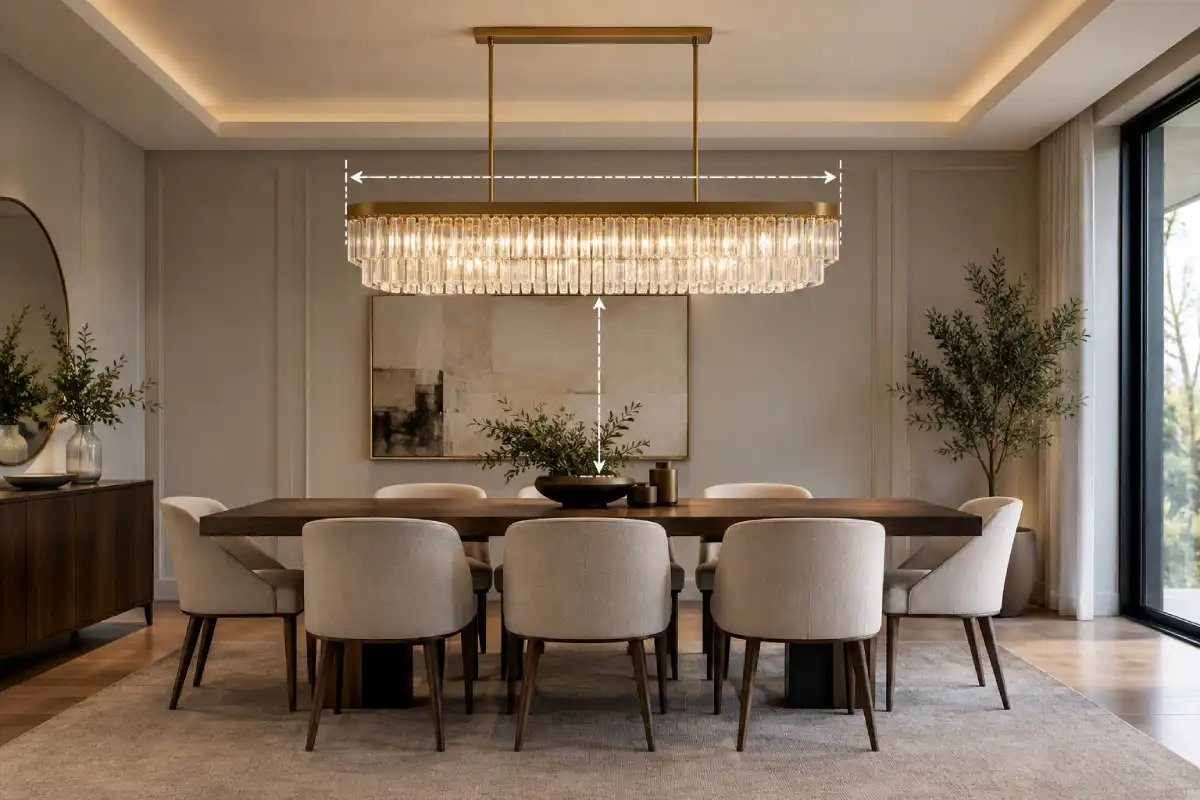
Linear chandeliers are long and narrow, with lights arranged along a horizontal bar or in a row. They’re made for rectangular spaces: over a long dining table, a kitchen island or a narrow gallery. As a rough guide, a linear piece over a table usually looks right at about two-thirds of the table’s length.
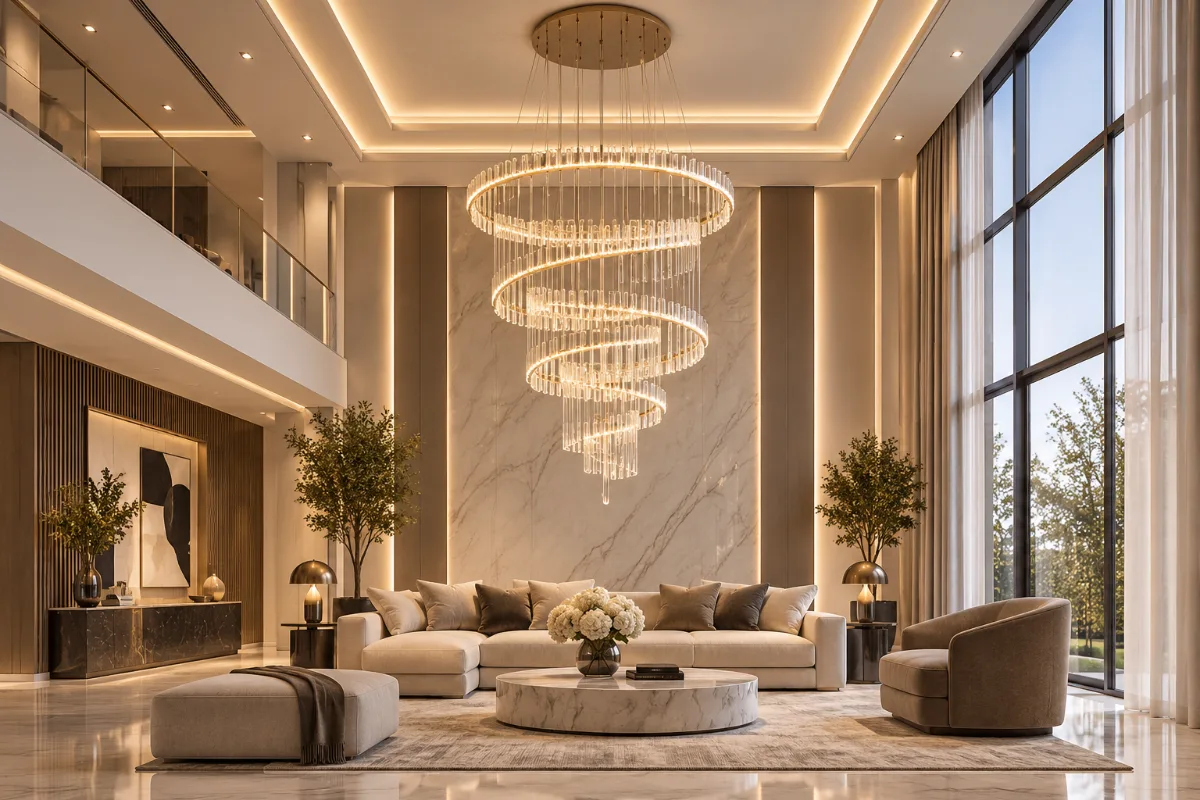
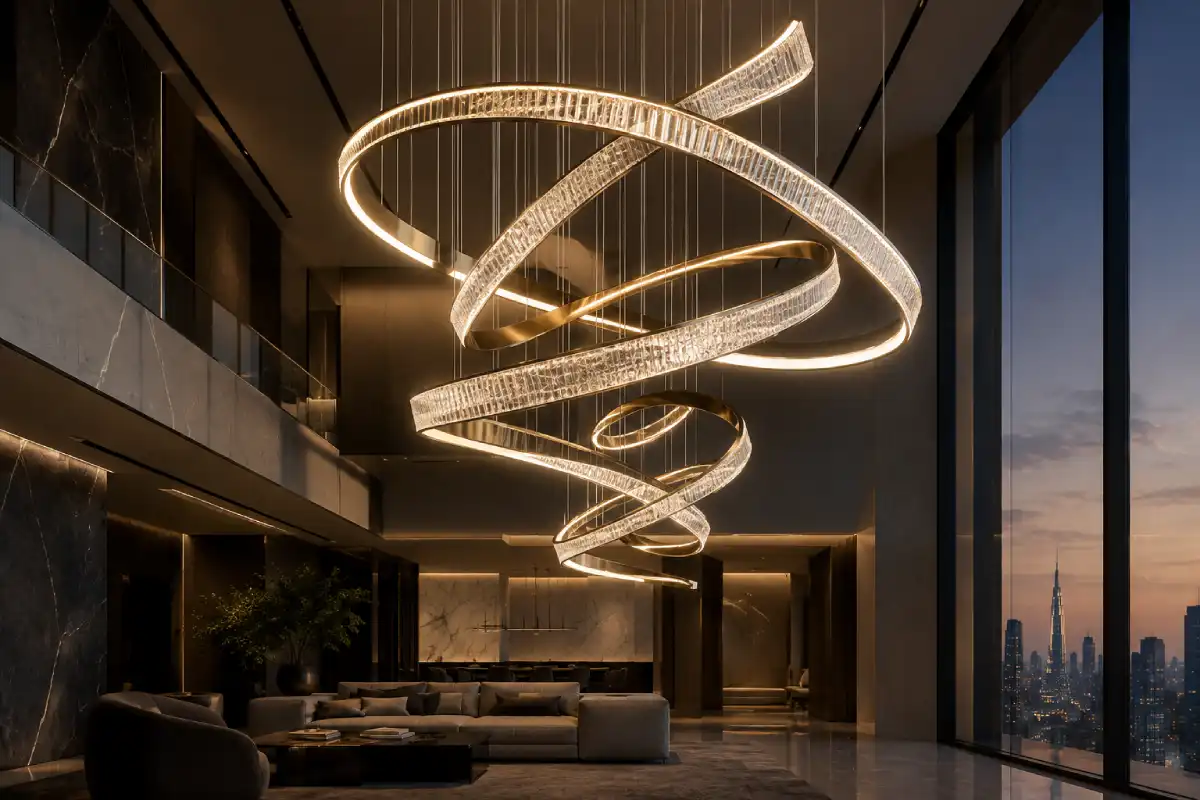
Ring chandeliers use one or more circular bands, either flat, stacked or set at different angles. A single ring feels light and contemporary. Multiple interlocking rings become sculptural and can fill a tall space without looking heavy, which is why they’re common in modern double-height living rooms.
Tiered chandeliers stack two or more levels of lights. This is the traditional way to give a chandelier height, and it’s the go-to shape for tall foyers and stairwells. In crystal, tiered pieces read as classic. In glass or slim metal, the same structure can look surprisingly modern.
Quick Decision Guide
Use this as a shortcut. If your room fits more than one row, look at the architecture first, then the furniture.
| Room | If the interior is… | Styles that usually work | Shapes to consider |
|---|---|---|---|
| Grand foyer / entrance | Formal, high ceiling | Classic, statement | Tiered, cascade |
| Double-height living room | Contemporary | Modern, statement | Ring, multi-ring, sculptural |
| Formal majlis or reception | Traditional or neoclassical | Classic, antique | Tiered, candle-arm |
| Dining room | Mixed classic and modern | Transitional | Linear or round, sized to the table |
| Kitchen island | Modern | Modern, transitional | Linear |
| Staircase / stairwell | Any | Statement, classic | Tiered, cascade, spiral |
| Master bedroom | Calm, layered | Transitional, modern | Single ring, small tiered |
| Apartment living area | Lower ceiling, open plan | Modern, transitional | Flush ring, compact linear |
If you’re still stuck between two options, transitional is almost always the safer bet. It’s easier to dress a transitional chandelier up or down with the rest of the room than to make a strongly classic or strongly modern piece fit an interior it wasn’t designed for.